Industrial Wire Shelving
NSF certifications, split-sleeve locking mechanisms, and post increments dictating modularity. Learn why zinc-plated steel outperforms standard coatings in high-humidity environments.
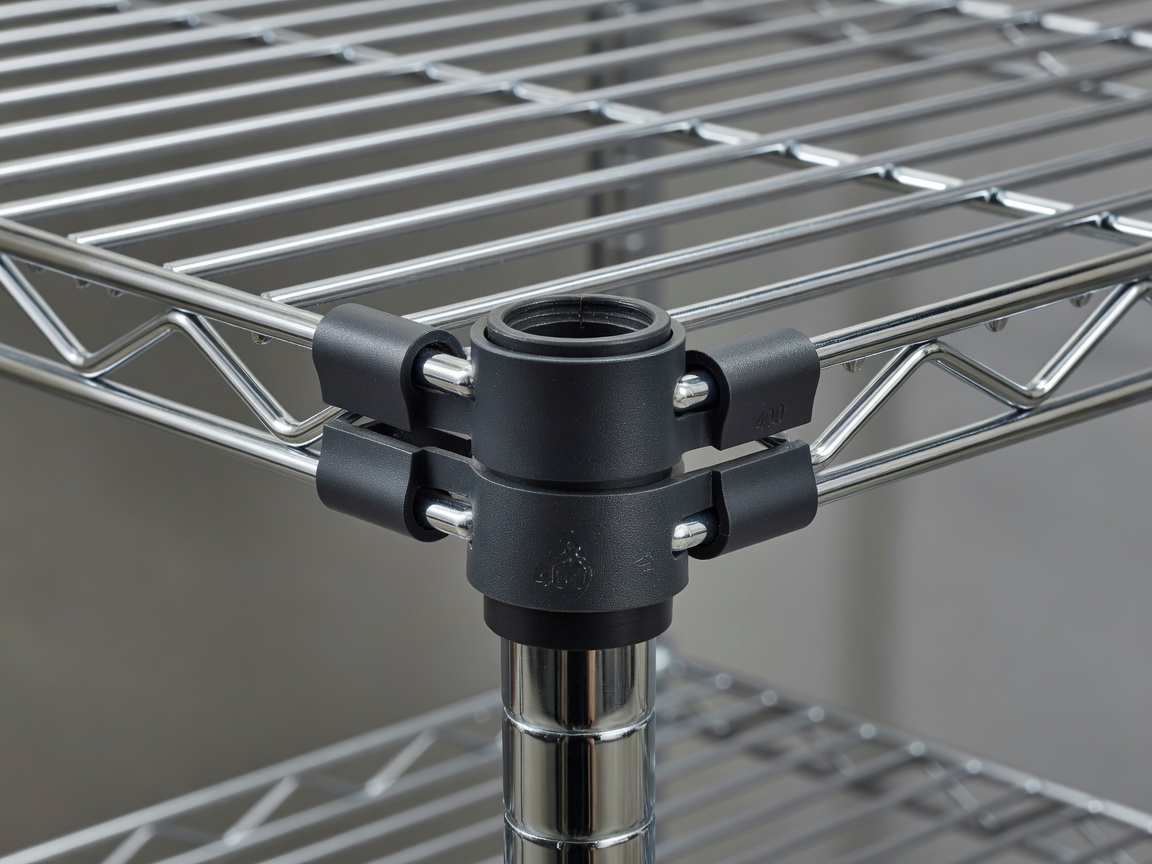
The Anatomy of the Split-Sleeve Mechanism
Industrial wire shelving operates on an elegantly simple physics principle: compression locking. The system relies entirely on tubular steel posts grooved at precise one-inch increments, plastic split sleeves, and the tapered metal collars welded to the corners of each wire shelf.
During assembly, two halves of a plastic sleeve are snapped into a groove on the vertical post. As the shelf is lowered over the post, the tapered metal collar of the shelf slides over the plastic sleeve. Because the collar is narrower at the top than the bottom, downward pressure forces the plastic sleeve tighter against the post. The heavier the load placed on the shelf, the tighter the mechanism grips. This eliminates the need for screws, bolts, or complex tools during assembly, while providing immense structural stability.
Load Capacities and Wire Trusses
The structural rigidity of a wire shelf comes not just from the perimeter frame, but from the zig-zag wire trusses running underneath the flat surface. These trusses act similarly to bridge supports, distributing weight across the span to prevent the primary wires from bowing.
Standard commercial units typically feature weight capacities ranging from 300 to 800 pounds per shelf, assuming the weight is evenly distributed. Point loading—placing a massively dense object in the center of the shelf—can still cause failure by bending the individual wire spans, even if the total weight is under the rated capacity.
Environmental Finishes and NSF Certification
In commercial settings, particularly foodservice and healthcare, shelving is subject to rigorous environmental stresses. The finish applied to the raw steel dictates its lifespan and application suitability.
- Chrome Plating: The most common finish. It provides a bright, clean aesthetic and is highly durable in dry environments (retail, dry storage, electronics). However, chrome will rust if exposed to high humidity or harsh cleaning chemicals over time.
- Zinc Plating with Epoxy: Often green or black, this finish involves zinc-plating the steel to prevent rust, then dipping it in an epoxy resin which is baked on. This creates a barrier highly resistant to moisture, making it the standard for walk-in coolers, freezers, and dishwashing areas.
- Stainless Steel: The ultimate commercial standard. Solid stainless steel resists corrosion intrinsically, without relying on a surface coating that could chip. It is mandatory in many sterile healthcare environments, though significantly more expensive.
NSF Certification
You will frequently see wire shelving marketed as "NSF Certified." The National Sanitation Foundation tests equipment for public health safety. For shelving, an NSF mark guarantees that the unit is designed to prevent the harboring of bacteria. This means smooth welds, no sharp crevices where food particles could lodge, and finishes that can withstand rigorous, frequent sanitization without degrading. If shelving is being specified for commercial food prep or medical storage, NSF certification is generally a non-negotiable requirement mandated by health inspectors.
Airflow and Dust Mitigation
Beyond structural integrity, the primary functional advantage of wire shelving is permeability. The open-wire design allows light to pass through, improving visibility in warehouse aisles. It permits free air circulation, essential for temperature uniformity in cold storage and server rooms. Finally, it dramatically reduces the surface area available for dust accumulation, reducing maintenance overhead and meeting stringent fire code regulations (as the open design does not block overhead sprinkler systems).