Floating Shelves
Concealed bracket systems demand specific wall conditions. We examine torsion limits, drywall anchors versus stud mounting, and deflection in engineered wood versus solid timber.
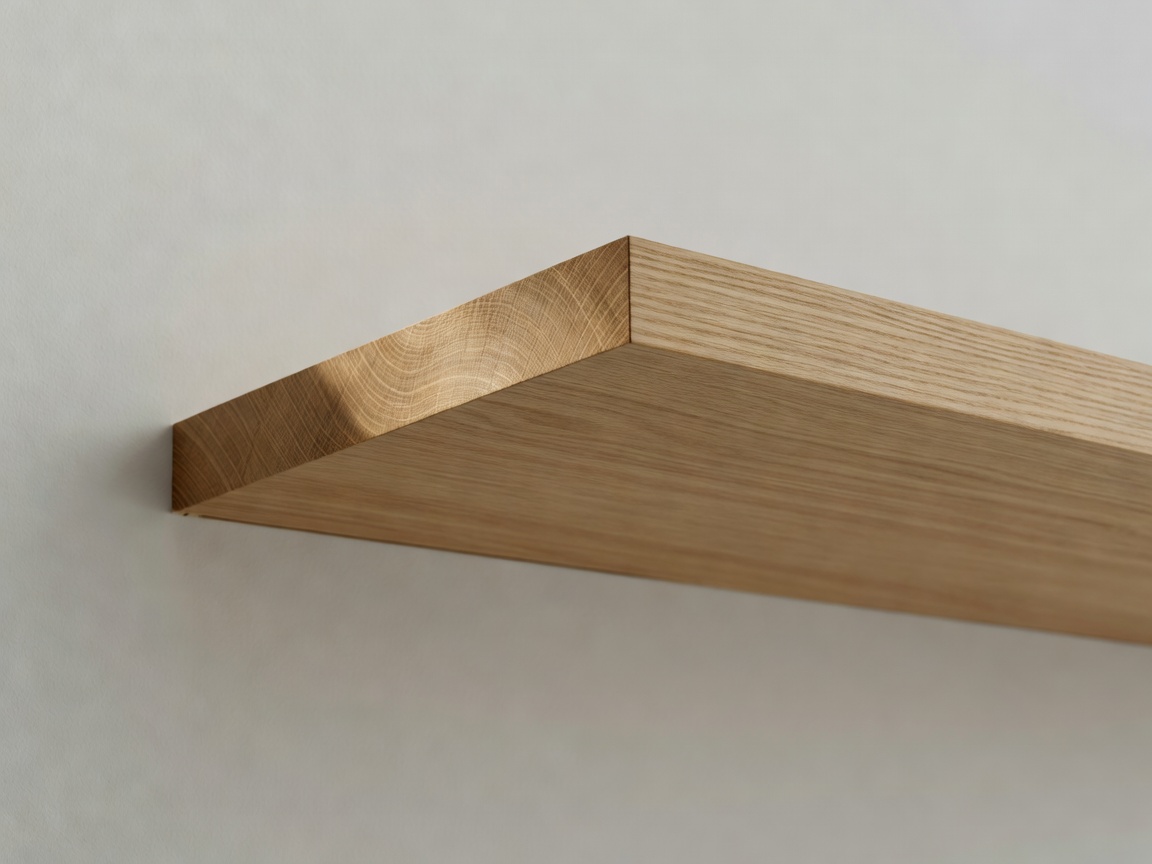
The Mechanics of Concealed Support
The defining characteristic of a floating shelf is the absence of visible support brackets. Achieving this minimalist aesthetic requires shifting the structural load entirely onto a concealed bracket, usually consisting of a backplate fastened to the wall and rods extending outward into the shelf body.
Because there is no diagonal bracing, floating shelves are subject to significant torsion (twisting force) where the shelf meets the wall. The longer the shelf extends outward (depth), the greater the leverage acting upon the mounting screws. Consequently, the depth of a floating shelf is inherently limited by the shear strength of its fasteners and the material of the wall.
Mounting Surfaces and Fasteners
Installation success depends almost entirely on the mounting substrate. Wall typologies fall into three broad categories:
- Drywall with Timber Studs: The gold standard for residential installation. Fastening directly into timber studs (typically spaced 16 or 24 inches apart) provides the highest load capacity. Heavy-duty lag screws can handle substantial shear forces.
- Hollow Drywall: When studs cannot be aligned with the bracket's mounting holes, specialized hollow-wall anchors are required. Toggle bolts distribute the load over a wider area behind the drywall, but the overall weight capacity of the shelf drops significantly compared to stud mounting.
- Masonry (Brick or Concrete): Extremely strong, provided the correct expansion anchors are used. Masonry allows for bracket placement anywhere on the wall plane without hunting for studs.
Material Selection and Deflection
The shelf body itself must be rigid enough to resist bending under load, a property known as deflection. Materials behave differently when suspended horizontally:
Solid Timber: Hardwoods like oak, maple, and walnut have high elastic moduli, meaning they resist bending extremely well. They are dense, heavy, and can support significant weight over long spans without sagging. However, their own mass contributes to the load on the bracket.
MDF (Medium Density Fiberboard): A composite material that is uniform and smooth. MDF is heavier than many softwoods but lacks the internal grain structure of solid timber, making it more prone to sagging over spans exceeding 36 inches unless reinforced internally.
Hollow-Core: Many commercial floating shelves are hollow boxes constructed from thin veneers over a cardboard or honeycomb internal structure. These are incredibly lightweight, minimizing the strain on the wall anchors, but they are easily crushed or punctured and generally support very little weight—often limited to 10-15 pounds.
Bracket Types
The internal hardware dictates both the weight capacity and the required thickness of the shelf.
- Post Brackets: Individual steel rods welded to small baseplates. These require precise drilling in the shelf back but allow for independent placement. Best for lighter loads.
- T-Brackets or H-Brackets: A continuous steel backplate with multiple rods welded perpendicular to it. The continuous plate provides immense rigidity and allows installers to hit multiple studs across a wide span. This is the professional standard for high-capacity floating shelves.
Calculating Practical Loads
A common misconception is that a shelf rated for "50 pounds" can support 50 pounds placed anywhere on its surface. Load ratings typically assume uniformly distributed weight. Placing a dense, heavy object (like a bronze sculpture) at the extreme front edge of the shelf maximizes the leverage against the wall anchors, potentially causing failure even if the object weighs less than the shelf's maximum rating. Always keep heavy items as close to the wall as possible to minimize torsion.