Bookshelves & Bookcases
Load distribution matters when dealing with heavy volumes. Explore the differences between fixed and adjustable joinery, material yield strengths, and the necessity of structural backings.
The Physics of Paper
Books are deceptively heavy. A single cubic foot of solid paper can weigh between 40 and 60 pounds, depending on the paper density. When designing or selecting a bookcase, the primary structural challenge is accommodating this dense, continuous load without succumbing to material fatigue or lateral racking.
Material Span Limits
The most common failure in a bookcase is shelf sag (deflection). Over time, static loads cause horizontal members to bow downwards. The degree of deflection depends on the material's thickness, its composition, and the distance between vertical supports (the span).
- Particleboard / Melamine: Common in flat-pack furniture. It has very low resistance to bending. A 3/4-inch thick particleboard shelf will typically begin to sag if it spans more than 24 to 28 inches under a full load of books.
- Plywood (Veneer Core): Superior to particleboard due to alternating grain directions in its layers. A 3/4-inch plywood shelf can safely span roughly 32 to 36 inches before noticeable sagging occurs.
- Solid Hardwood: Materials like oak, maple, and cherry offer the highest stiffness. A 3/4-inch solid hardwood shelf can often span 40 to 48 inches without sagging, provided the load is evenly distributed.
To increase span capacity without switching materials, manufacturers often increase the thickness of the shelf to 1 inch or add a rigid structural lip (a nosing) to the front edge.
Structural Integrity and Racking
Freestanding bookcases face a secondary threat: racking. Racking is the tendency of a rectangular frame to fold into a parallelogram under lateral stress. This is combated through two primary methods:
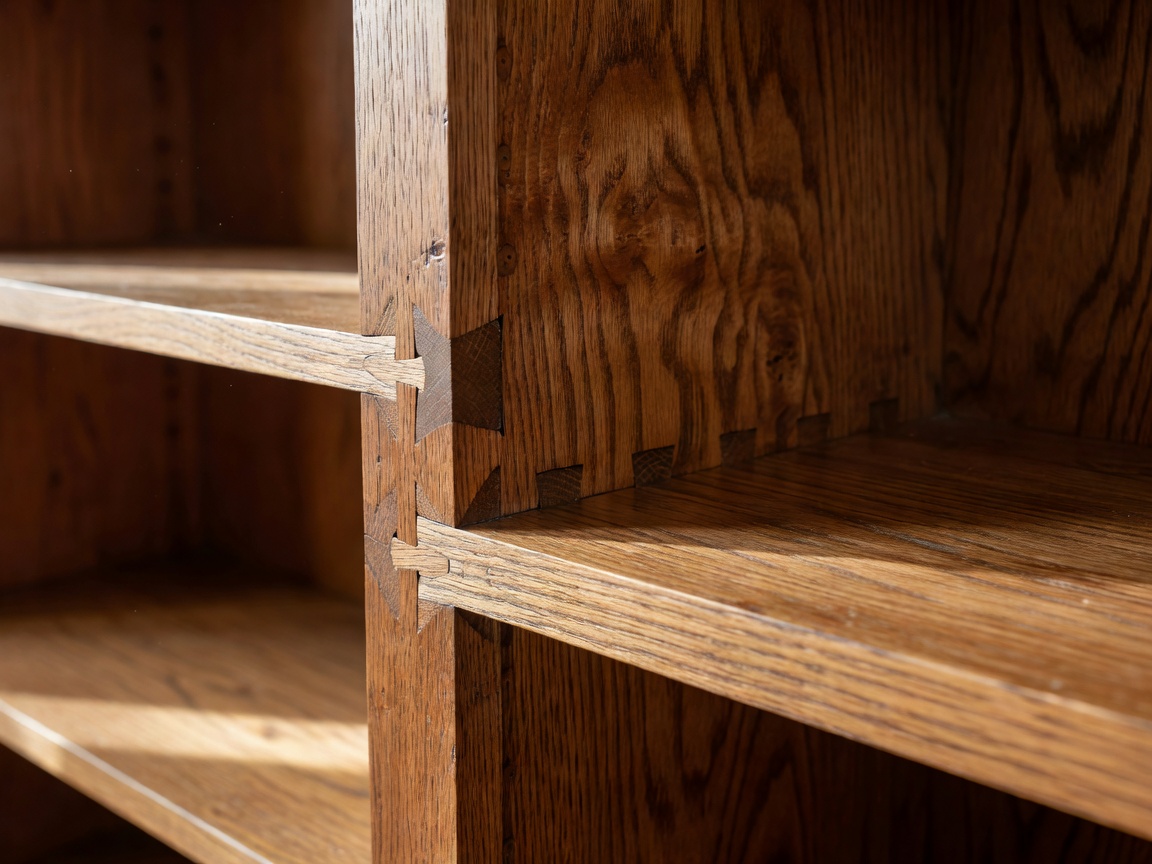
Fixed Joinery: Shelves that are permanently attached to the side panels (via dadoes, dowels, or cam-locks) act as structural tie-rods, preventing the sides from bowing outward and keeping the overall frame square. The drawback is a loss of flexibility—shelf heights cannot be adjusted.
The Back Panel: The most crucial structural element of many bookcases is often the thinnest. A rigid back panel (even just 1/4-inch plywood) fastened securely to the top, bottom, and side panels creates a shear wall. This diaphragm prevents the unit from racking side-to-side. Flat-pack bookcases that rely on a thin cardboard back tacked on with small nails are structurally inferior and highly prone to racking if the nails fail or the cardboard tears.
Adjustable Shelving Mechanisms
For flexibility, many bookcases utilize adjustable shelves supported by pins. The hardware choice directly impacts load capacity.
- Plastic Pegs: Common in low-cost furniture. They can shear off under heavy loads or become brittle over time.
- Steel Spoons / Pins: A cylindrical pin with a flat paddle that the shelf rests on. Significantly stronger than plastic and standard for commercial cabinetry.
- Pilaster Strips: Metal tracks routed into the vertical sides of the bookcase, into which metal clips are inserted. This system distributes the load along a continuous vertical plane and is standard in high-end or institutional library shelving.
Safety and Anti-Tip Anchors
Regardless of construction quality, heavily loaded bookcases possess a high center of gravity. In seismically active areas, or environments with children, freestanding bookcases represent a significant tipping hazard. Wall anchoring is not an optional aesthetic choice; it is a critical safety requirement. Anchors should tie the uppermost structural frame of the bookcase directly into a wall stud, countering rotational forces that would cause the unit to pitch forward.